Tracts/Fr. Joseph the Indian and his “Catholicos”
The sayings of a sixteenth-century Indian priest concerning his native Church and its Primate, as recorded by contemporaneous Western sources, are quite important pieces of evidence for any inquiry into the history of the Malankara Church. The present article scrutinises a recent claim about the identity of his Primate.
By David George
10 May, 2026
Introduction
In 1490, three men from Malankara travelled to Jazira (modern-day Czire, Turkey), in order to meet the “Nestorian” Catholicos-Patriarch of the East. Though one of them passed away en route, two of them — Joseph and George — reached their destination, and were ordained as priests by Cath. Shemʿon IV (d. 1497). About ten years later, Fr. Joseph and his brother (who died during this journey) travelled to Rome, Lisbon, and Venice, where his account concerning the Church in India became the first credible attestation of the Indian Christians recorded in early modern European sources.
Now, Catholic and Jacobite authors in recent times have understood the preserved sayings of Fr. Joseph in varying ways so as to suit their own frameworks concerning the nature and orientation of the early Malankara Church, to the point of anachronistically interpreting them independently of their surrounding context. In a recent live-stream by Lion's Den on YouTube, Sarah Knight claimed Fr. Joseph told Pope Alexander VI that he was “going to Antioch” (!), where he would “receive consecration as a bishop” (!) from the hands of the Patriarch of Antioch. She later defended her position in a brief article responding to my comment under the published stream, where Knight concludes “that the destination of Joseph the Indian could not have been anything but Antioch [..] and the Maphrian/Catholicos under him”. In this article, I will analyse Fr. Joseph's preserved sayings and demonstrate why Knight's view, contingent upon an extreme misreading of the data, is evidently untenable.
The primary source preserving (albeit somewhat garbledly) Fr. Joseph's oral account is the contemporaneous Italian grammarian Fracanzano da Montalboddo's (ca. 1500-22), who published it in his anthology Paesi nouamente retrouati et Nouo Mondo da Alberico Vesputio Florentino intitulato (1507). We will consult Fracanzano directly in order to avoid confusion caused by later, Catholic and Protestant, sources who depended on Fracanzano's narrative either directly or indirectly.
What was Fr. Joseph's destination?
Before we proceed to Fr. Joseph's remarks, the questions of (a) where he went and (b) who he met should be sufficiently answered. Thankfully, we have a contemporary, independent source attesting to this matter: the East Syriac monk Rabban ‘Brahim of Beth Slokh who wrote the report History of the Blessed Indians and on their Arrival in the City of Gazarta d-Beth Zabday shortly afterwards.
Now, in the year thousand eight hundred and one according to Alexander [1489/90 CE], three Christian faithful men had come from the far-away lands of India to Mar Šem’on, Catholicos Patriarch of the East, so that they may take with them Fathers (Abāhātā) to their lands. According to the will of the Creator one of them passed away on the way. Two arrived safely to the Mar Catholicos. The Mar Catholicos was in the city of Gazarta d-Beth Zabday and he rejoiced upon them with great and abundant joy. One of them was called George, the other Joseph. The Mar Catholicos ordained both as priests in the holy church of Saint George of Gazarta, because they were learned men.
- Istvan Perczel, "New Evidence on the Sixteenth-Century East Syriac Missions in the Malabar Coast: The Muttuchira Inscription (1581 CE) in Context" (Entangled Religions 11:5, 2024), p. 4
E. M. Philip had, in fact, granted this in his Indian Church of St. Thomas (1908), when he writes that the “Syrian community of Malabar sent a deputation of three faithful members”, two of whom, named Joseph and George, “were conducted to the Nestorian Patriarch Mar Simon” (p. 89). In other words, it is clear that the deputation from Malankara was headed to the seat of the Catholicos-Patriarch of the Church of the East.
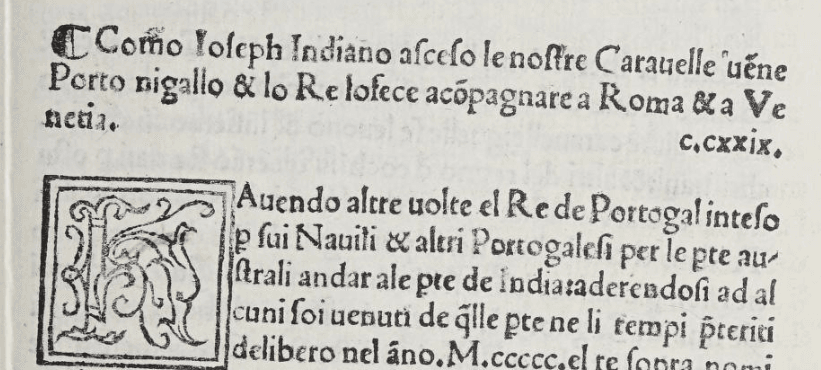
Text and Translation: Fracanzano (1507)
Note: Archaic letters have been modernised, and scribal abbreviations expanded for readability.
Questi christiani predicti in rebus diuinis hã[n]no p[er] capo loro uno Pontifice: Cardenali.xii. Patriarchi.ii. Veschoui: & Archiueschoui: Referisse el predicto Joseph lui esser partito cum uno suo patrone Veschouo de la dicta Cita de Caranganor: & montado in naue ando uerso la insula de Ormus: la qual e lutan dal dicto loco de caranganor miglia .M.ccccc. & de li passo in terra ferma per mesi.iii. de zornate: se ne uene in sieme cum dicto Veschouo fino in Armenia a trouar el suo pontifice: dal qual esso Veschouo fo consechrado: & pre Joseph predicto ordinato da messa: el simile fã[n]no tutti li christiani de India & del cataio: Questo suo pontifice se chiama Catolicha: & ha la testa rasa ad formã[m] crucis: fa sui patriarchi: ut superius dictum ẽ[st]: uno uidelicet nel India: laltro al cataio: li altri ueschoui & archiueschoui: come e dicto de sopra: manda a le sue p[ro]uincie: come a lui pare. de questo Catholicha ne e facto mentione in marcho polo doue tracta de larmenia: in quel loco dice esser due generatiõ[ni] de christiani: una de le qual se chiama Jacopiti: laltra nestorni: & dice loro hauer uno Papa el qual se chiama Jacolita: che e questo Catholicha: che dice pre Joseph prenominato: dice insuper insuper el d[i]cõ[to] Papa far Veschoui: Archiueschoui: & Patriarchi: & mandano nel India: potriano esser alcuni che dirano che auctorita hauesse questo Pontifice: el Pontifice nostro Alexandro: essendo pre Joseph predicto a roma & parlando cum sua sanctita de le parte de India: et Pontifice dimando chi haueua dato q̃[ue]sta auctorita al suo Catholicha: & pre Joseph li respose: che al tempo de Simon mago scõ[sancto] Pietro era Pontifice in antiochia: & essendo ne le p[ar]te d[i] Roma molestadi li christiani p[er] larte de q̃[ue]sto Simõ[n] mago: nõ[n] hauendo niuno li potesse obstar: fu mandato a suplicar a san Pietro: che se uolesse transserir [transferir] sino a Roma: qual lassando uno suo Vicario: uene a roma: & questo e quello: che al p̃[re]sente se chiama Catolicha: & gerit uicẽ[m] petri: cerca el far del d[i]cõ[to] Pontifice: o uer Catholica li.xii. Cardinali p̃[re]dicti se reducano ne la p[ro]uincia d[i] Armenia: doue fã[n]no el pontifice loro: qual auctorita dieono [deono/dicono] hauer dal Pontifice Romano.
These aforementioned Christians [of Malankara] in divine matters have as their head a Pontiff, twelve Cardinals, two Patriarchs, Bishops, and Archbishops. The aforementioned Joseph reported that he departed with his patron [master], the bishop of the said city of Caranganore [Cranganore]: and having boarded a ship went toward the island of Ormus: which is distant from the said place of Caranganore 1,500 miles. And from there he passed to the mainland for a journey of three months of days. He went together with the said bishop as far as Armenia to find his Pontiff, by whom this bishop was consecrated, and the aforementioned priest Joseph [was] ordained to [say] Mass: the same is done by all the Christians of India and of Cathay [China]. This Pontiff of theirs is called Catholicha [Catholicos], and has his head shaved in the shape of a cross: he makes his Patriarchs, as is said above: one namely in India [and] the other in Cathay [China]; the other bishops & archbishops, as is said above, he sends to his provinces as he sees fit. Of this Catholicha mention is made in Marco Polo where he treats of Armenia. In that place he says there are two generations [kinds] of Christians, one of which is called Jacopiti [Jacobites], the other Nestorni [Nestorians]. And [Marco Polo] says they have a Pope who is called Jacolita, who is this Catholicha of whom the pre-named priest Joseph speaks. He says moreover [that] the said Pope makes Bishops, Archbishops, & Patriarchs, and they send them to India. There might be some who will say [ask] what authority this Pontiff might have. Our Pontiff Alexander [Pope Alexander VI of Rome], the aforementioned priest Joseph being in Rome and speaking with His Holiness about the parts of India, the Pontiff [i.e. the Pope] asked who had given this authority to his Catholicha. And priest Joseph answered him, that at the time of Simon Magus Saint Peter was Pontiff in Antioch; and the Christians in the parts of Rome being harassed by the arts of this Simon Magus, not having anyone who could oppose him, they sent to supplicate Saint Peter, that he should want to transfer himself to Rome, who leaving a Vicar of his, came to Rome. And this is the one who at present is called Catholicha, and he acts in the place of Peter. Concerning the making of the said Pontiff, or rather Catholica, the twelve aforementioned Cardinals gather in the province of Armenia, where they make their Pontiff: which authority they claim [or ought] to have from the Roman Pontiff. (Sec. 133)
The text, as mentioned above, is partly garbled, but the key takeaways may be: (a) the Christians of Malankara have a “Pontiff”, twelve “Cardinals”, two “Patriarchs”, and other Archbishops and Bishops; (b) the bishop of Cranganore was consecrated by this Pontiff titled Catholicos, who also ordains all for the Christians of India and China; (c) this Catholicos consecrates two Patriarchs, one for India and the other for China; (d) Marco Polo mentions this Catholicos in his work; (e) the Catholicos is the vicar [and successor] of St. Peter, before he went to Rome and became the Primate there; (f) the Catholicos is elected by twelve “Cardinals”; (g) the authority of the twelve “Cardinals” is said to be from the Pontiff [i.e. Pope] of Rome.
There is much to be noted here. For instance, the ecclesial praxis of twelve subordinates — properly, priests — electing and consecrating their hierarch (from among them) was not a West or East Syriac practice but a very early Alexandrian tradition, which also existed in Malankara to some degree. Similarly, it was not the “Nestorian” Catholicos of the Church of the East who had two Patriarchs under him, but the Catholicos of All Armenians, under whom two Patriarchates — of Constantinople and Jerusalem — still function.
Marco Polo's Catholicos
Knight makes the subtle contention, based on a misreading of both Marco Polo and Fracanzano (indirectly, since she does not appear to have consulted this primary source but later reproductions or summaries of the same), that the narrator of Fr. Joseph's statements identified his Catholicos as the Maphrian-Catholicos of the Syriac Orthodox Church. To quote from her:
Which Patriarch and which Catholicose is JI talking about? The answer is on p. 231-3: ‘Marco Polo, the Venetian, speaks of this Catholica in his treatise on Armenia, and says that there are two kinds of Christians, the Jacobites and the Nestorians, whose Pope is called Jacobita [error in terminology, as spoken by JI, or as heard or as understood by his interlocutor. Read ‘Jacobite.’] This is the Catholicose about whom we are speaking here. (The words of Marco Polo are: The Christians are Nestorians and Jacobites. These have a Patriarch called by them Jacelich [again an error in terminology as spoken or as understood. Read ‘Catholocose.’] We follow the Antwerp edition of the year 1563.)’
This is, however, plainly false. Fracanzano does not quote from Marco Polo as mentioning the Pontiff being titled Jacobita, but Jacolita: that is, “Catholicos” (similar to Ar. jathaliq). Therefore, there is no confusion between the terms "Jacobite" and "Catholicos". Moreover, Marco Polo simply states that the Christians of Mosul — without specifying whom, i.e. the Nestorians, the Jacobites, or the Armenians — have a Catholicos as their Pontiff (Travels VI). This is equally true for all of the mentioned denominations, since all of them had their chief-hierarchs possessing the office of the Catholicos, and therefore one cannot argue from this that the Catholicos of our concern here was precisely the Primate of one denomination among these.
Fr. Joseph and Antioch
We finally come to the major point. Knight claims that Fr. Joseph's Catholicos was the Maphrian-Catholicos under the Syriac Orthodox Patriarch of Antioch, since he mentions “Antioch” while speaking of his Pontiff. From her remarks:
P.233: ‘He (Pope Alexander VI) asked Joseph from where this Catholicos had the authority for making bishops in the countries of the East. The latter answered him that St. Peter had been bishop in Antioch [notice how Joseph brings in ‘Antioch’ here] ……… Before Peter went from Antioch to Rome he installed in his place a vicar whose descendent (in a following succession) is precisely the same who rules the Eastern regions [here Joseph says unambiguously, that this hierarch, that is, the Patriarch in Antioch, consecrates the Catholicose who rules the Eastern regions], and bears the name of Catholica. He is elected to the high office by the twelve cardinals in Armenia.’
As any reader who compares the primary text with Knight's comments (in square brackets) would realise, they rest on a ground consisting solely of misreadings. To demonstrate this, let us quote the relevant sentences from Fracanzano:
Our Pontiff Alexander [Pope Alexander VI of Rome], the aforementioned priest Joseph being in Rome and speaking with His Holiness about the parts of India, the Pontiff [i.e. the Pope] asked who had given this authority to his Catholicha [Catholicos]. And priest Joseph answered him, that at the time of Simon Magus Saint Peter was Pontiff in Antioch; and the Christians in the parts of Rome being harassed by the arts of this Simon Magus, not having anyone who could oppose him, they sent to supplicate Saint Peter, that he should want to transfer himself to Rome, who leaving a Vicar of his, came to Rome. And this is the one who at present is called Catholicha [Catholicos], and he acts in the place of Peter.
There are three clear points here: (a) as to the source of the Catholicos's authority, (b) when St. Peter was Pontiff in Antioch and had to leave for Rome, (c) he left a Vicar who is currently called Catholicos and acts as the representative of St. Peter. Knight cannot understand (c) within her ahistorical paradigm by any means, and therefore has to wholly misrepresent it by introducing a Patriarch of Antioch who is said to consecrate the Catholicos, whereas Fr. Joseph is explicit that it is the Catholicos himself who is the Vicar and successor of St. Peter. Prima facie, then, we may set aside Knight's plainly inaccurate deduction.
Fr. Joseph's ecclesial notion of the Catholicos of the East being the Vicar and successor of St. Peter for the East makes sense under the framework of a single denomination: that of the medieval Church of the East, i.e. the Nestorian Catholicate, which claimed the office of St. Peter to some degree, and understood their Catholicoi to be the successors of St. Peter. The four Nestorian bishops sent to India in 1504 describe Cath. Šemʻun VI in the following manner in their letter addressed to him:
To Šemʻun II, the Pope of our days, Ṭīmāṯeus of our era, Yēšūʻ bār Nūn of our times, Yēšūʻyā/h/b of our seasons, who was given power in heaven and on earth, to shepherd the Christ’s sheep with Peter’s staff which he has inherited for the time which is destined for him.
- Michael Abdalla, “On Christianity in the Indian Malabar Coast and on the arrival of the Portuguese in a Syriac document from 1504” (Orientalia Christiana Cracoviensia 3, 2011), p. 31
This Petrine notion within the Church of the East concerning the See's succession was not a late phenomenon. Already in 424 CE, the Synod of Dadisho (at Merkabta) affirmed the Catholicos of the East as being the “one faithful steward” who possesses, like St. Peter, “the unique principality or spiritual paternity” over the Church, which was “not given to all [the Apostles]”. Similarly, the later Synod of Mar Hananisho' II in 775 CE declared that the one who reigns on the See of the Catholicate “is himself Peter, because he is the heir of Peter” (Scott Butler and John Collorafi, Keys Over the Christian World, pp. 535-7). With the quote from the early-sixteenth-century letter quoted above, it is readily evident that this notion of the Catholicos being the successor of St. Peter continued to be predominant within the Nestorian Church, especially in contexts connected to India. It may be concluded from this piece of information alone that Fr. Joseph the Indian is clearly referring to the Catholicos-Patriarch of the Nestorian Church of the East.
Conclusion
In the case of Fr. Joseph the Indian and the figure he deemed as his Primate, we have seen that we possess not merely internal, but also external evidence. His sayings, which are preserved by contemporaneous Western sources somewhat garbledly (they are, however, still reliable), confirm the external witness that he indeed received ordination from the hands of the Nestorian Catholicos-Patriarch and recognised him as his, as well as Malankara's, Pontiff.
What led Sarah Knight to conclude otherwise? We have seen that she did not consult the earliest and major primary source for Fr. Joseph's sayings, as well as Rabban ‘Brahim of Beth Slokh. Moreover, she misinterpreted them for the sole reason that a plain understanding of Fr. Joseph did not cohere with her own view, which is that the See of Antioch (and the Maphrianate under it) possessed some sort of absolute, spiritual (and temporal?), jurisdiction over Malankara since the beginning.