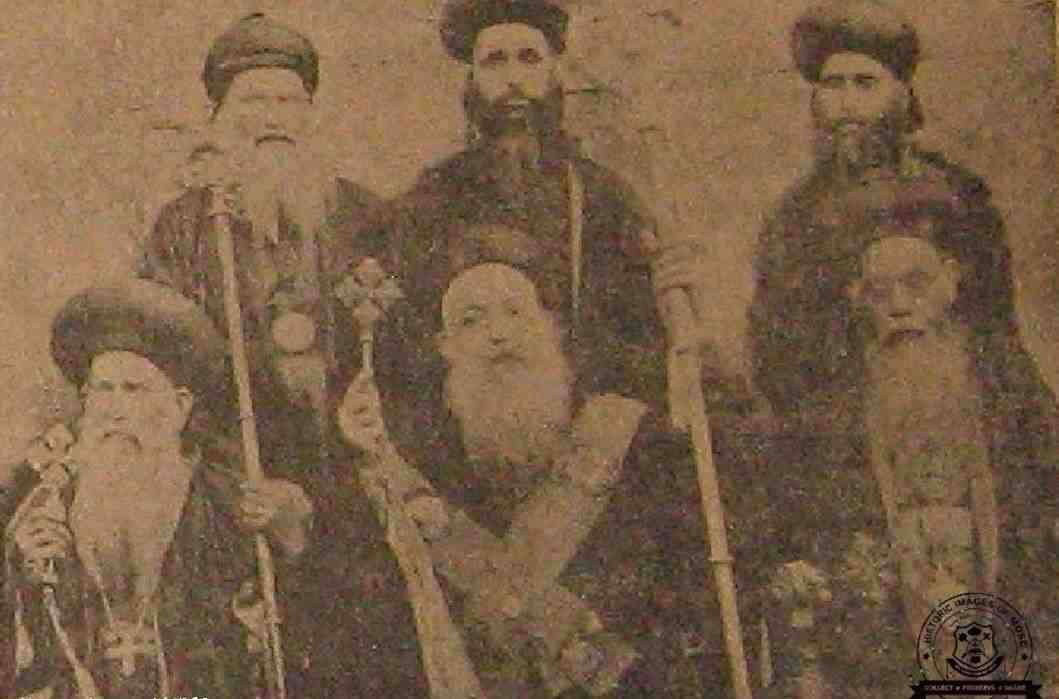
Tracts/Pat. Abded Mshiho II and the 1903 “Synod of Deposition”
On the controversy surrounding the nature of the deposition of Pat. Abded Mshiho II. Was it an ecclesiastical, or merely political act? Did the Patriarch continue to be a spiritually valid Primate? These questions are answered in light of contemporaneous evidence.
By David George
30 August, 2024 / 20 June, 2026
Context
Patriarch Abded Mshiho (Ar. Abdul Masih) II of the Syriac Orthodox Church, who ascended to the Throne in 1895, was deposed in the early 1900s. The nature of this deposition — whether the Primate was deposed by the Church's Synod officially, or merely by the Ottoman Sultan's firman — has been a matter of dispute in the century-old “Orthodox-Jacobite” division in Malankara. The approach adopted towards the matter, therefore, must be evidence-based and objective. It will nevertheless be illustrated from contemporaneous evidence that the deposition was primarily legal than ecclesial, and that Pat. Abded Mshiho continued to be Patriarch.
Before we move on, there is an issue with the dating. Syriac Orthodox sources from the second and third quarters of the twentieth century state that a synod of the Syriac Orthodox Church in 1903 deposed Pat. Abded Mshiho, while slightly earlier Syriac Orthodox sources places this in 1905, and Malankara sources attest only to the deposition by the Sultan's firman, and not to a synod. To keep things simple, a specific date won't be presumed for the deposition.
Let us begin with the primary sources. For Sections II and III as well as multiple additional points, I am greatly indebted to Fr. K. P. Paulose's Kanonika Pathriyarkees Aaru ("Who is the Canonical Patriarch").
I: Malankara Edavaka Pathrika
Malankara Edavaka Pathrika (hereafter MEP) was a monthly magazine, officially published by the Church under the ownership of the then Malankara Metropolitan, Mar Dionysius V Pulikkottil. The journal covered contemporary ecclesiastical matters, offered rebuttals to Reformed critiques, and published formal news related to the Church. For our purposes here, the editions of MEP published between 1905 and 1906 present details concerning the deposition of Pat. Abded Mshiho.
MEP Edavom (May-June) 1905 edition has an entry titled “The Displacement of Patriarch”, in which it is noted that a couple of English sources report Pat. Abded Mshiho has been “deposed by the Turkish Government”. The entry continues that this is possible, since “previous letters received from Syria inform us that quarrels exist between the Patriarch and Turkish Government”. It links this matter to the existing Ottoman persecution of Christians (especially Armenians), and concludes with a report that the Sultan has ordered the Church to consecrate a new Patriarch to the Throne. The editor of the magazine further adds new information received from recent letters from Syria: Met. Dionysius Behnam of Mosul has been elected to execute the “temporal authority” of the Patriarch, and Met. Gregorios (later Pat. Abded Aloho / Abdullah II), who previously “wore the dress of a Roman Catholic” fearing the Government, has now returned since he gained the Government's favor.
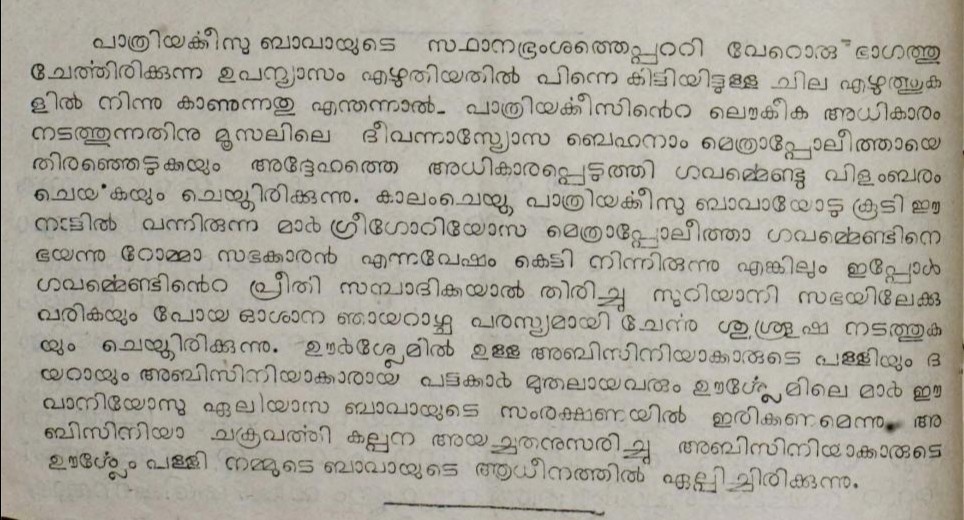
MEP Chingam (August-September) 1905 edition states the same — that Pat. Abded Mshiho has been deposed by the Ottoman Sultan — and further adds that a yogam (meeting) will be held soon to elect another to the Throne.
MEP Karkidakom (July-August) 1906 edition publishes the recent letter from Deacon T. A. Matthai (later Catholicos Augen I) in Syria: Met. Gregorios has been unanimously elected as the Patriarch, and the Government of Turkey has issued an order stabilising his position. The editorial notes of this edition are pretty interesting, especially concerning our matter. Firstly, it is repeated that since the Turkish Government ordered Pat. Abded Mshiho to relinquish his position, Met. Dionysius Behnam of Mosul carried out the temporal functions of the Patriarch, and “it has been around two years since there has been no one to execute the spiritual functions of the Patriarch, such as the consecration of bishops and blessing of chrism”. Secondly, the editor expresses an agnostic view towards the cause for the deposition: he notes that sources are divergent concerning whether the Patriarch was deposed due to the disfavour of the Government or of the Church as well, and doesn't make a particular conclusion. Thirdly, the former outlook on Pat. Abded Aloho (formerly Met. Gregorios) has changed, most probably due to his ascension. He is now described quite positively, as one who had to switch his Church due to the political circumstances.
The information conveyed by MEP between 1905 and 1906 can be summarised in the following manner: Pat. Abded Mshiho II was deposed by the Ottoman Government for political or religio-political reasons, and Met. Gregorios who was formerly a Syrian Uniate has been elected as Pat. Abded Aloho II.
II: The Letters of the Deacons and Vice Consul Shipley
In 1906, two deacons were sent from Kerala to Syria, to inquire whether a Catholicate can be established in Malankara. Their letters were later quoted by the magazines Suriyani Sabha (1926: p. 326) and Sabha Chandrika (1950: pp. 113-114), both officially published by the Jacobite pro-Patriarch faction in Kerala.
In the first letter, the deacons note that “coming to know that His Holiness Old Patriarch had proceeded [Mal. ezhunalli] and is resting here [at the monastery], we arrived and stayed in his presence for three days”. The Malayalam terms used to signify reverence — thirumanassu, ezhunalli, aviduthe adukkal — are significant, given the context. Quite interestingly, the same terms are not applied while referring to Pat. Abded Aloho; we can only speculate the cause. The second letter is noteworthy enough to be quoted:
We discussed with the Old Groom [Pat. Abded Mshiho]. There are no difficulties in getting the office of Chor-Episcopos and the office of Maphrian. .. New Groom [Pat. Abded Aloho] is not willing, and we don't see a way around it.
The point is simple: Pat. Abded Mshiho II is still seen as a Patriarch, and matters such as the establishment of the Catholicate are or have to be discussed with him. Why would this be, if the Patriarch was formally deposed from the Throne by the Church, and the only reigning Primate was Pat. Abded Aloho?
The answer to this can be found in another contemporaneous letter: from the aforementioned Deacon Mathai, addressed to Fr. Geevarghese Malpan (later St. Dionysius the Illuminator, i.e. Mar Dionysius VI).
There was not much error in the old Patriarch: simply that he didn't have the favour of some foremen. The people of Tur Abdin only accept him. .. Some metropolitans have not been received by their dioceses after consecrating the new Patriarch, and they have to now stay at the monastery. .. The new Bava has an interest in collecting money from Malayalathu [i.e. Malankara].
- Cit. Ext. “B. M.” in the Fixed Deposit Suit; quot. Z. M. Paret, Malankara Nazranikal, Vol. 4, pp. 63-64).
This is further supported by Avalon Shipley's, then British Vice-Consul of Diyarbakır, letter to Sir N. O'Conor, British Ambassador to Turkey:
The Jacobite community throughout the country is being at the present moment greatly agitated by the struggle between the partisans of the ex Patriarch and the partisans of the Bishop of Mosul. The former was dismissed by Iradé at the request of a great majority of the priests and people some months ago, but has refused to relinquish his position. A majority of the Bishops agreed on the Bishop of Mosul as his successor, but the time required to allow them to meet at Mardin for the consecration has enabled the ex-Patriarch to set the usual machinery in motion and sow dissensions among them, the priests and the people. Money has been lavishly spent, with the result that there are now three camps – that wishing the ex-Patriarch reinstated, that insisting on the election of the Bishop of Mosul, and a third desirous of compromising by conferring the temporal power on a new Delegate while leaving the spiritual supremacy to the old Patriarch.
- F.O. 424 Further Correspondence/Asiatic Turkey, 1905 Inclosure No. 106 (dat. December 4, 1905)
It must be briefly noted what “a majority of the priests [bishops?]” are. Even according to the standard Syriac Orthodox narrative popular since the second quarter of the twentieth century, the Synod deposing Pat. Abded Mshiho was at best supported by nine metropolitans: five of whom are said to have attended personally, and the remaining four to have signed it, though importantly, these signatures lack dates (Met. Dolabani reports the total number of metropolitans to be eight, four of whom personally attended the Synod). There were many other prelates who did not attend this synod (if it happened), sign its decrees, or support it.
That being said, Shipley's attestation is crucial. For unknown reasons, by early 1906, a compromise seems to have occurred: a new Patriarch would be elected, but the former would continue, at least spiritually, in some manner. This would explain the accounts in the letters of the deacons, as well as a couple of other sources.
III: Konat Malpan
Konat Mathen Malpan's letter to Pat. Abded Mshiho II dat. Dhanu 30, 1908 is published by the aforementioned Sabha Chandrika 3 (1950), as well as in other sources. The relevant parts are quoted here.
To our Father His Holiness Moran Mar Ignatius Patriarch Abded Mshiho the Second, who reigns over the Syrian community spread over the world. [..] Patriarch Abdallah is avaricious.. and is the cause of all current shame. If a woman's husband desires to hurt or kill her, how will she live peacefully with physical pleasures, without inexpressible deep breathing and tears? Your Holiness is the rightful Patriarch. [..] If Your Holiness is our Father and we are your children, go forth divinely with haste, and stop Patriarch Abdallah's visit towards us [..]
- Cit. Ext. “F. J” [Syriac] & "F. K." [Malayalam] in the Fixed Deposit Suit; Z. M. Paret, Malankara Nazranikal, Vol. 4, pp. 72-73
Konat Mathen Malpan, nevertheless, would soon switch sides, probably due to personal quarrels with St. Dionysius. But his opinion on Pat. Abded Mshiho didn't change, until the Second Community Suit was filed. In a leaflet published by himself on Kumbham 5, 1910, titled Sookshmagrahi, he writes that Pat. Abded Mshiho is not “a deposed or a false Patriarch as certain malpans say”, but a canonical Patriarch — albeit one under house arrest.
The “Synod of Deposition”: Incoherent Accounts
Now that we have consulted the major contemporary sources, it would now be well to move on to the “Synod of Deposition” that supposedly deposed Pat. Abded Mshiho II, and the sources and accounts concerning it.
Firstly, the earliest Syriac Orthodox sources that mention a deposing-synod date to after 1911. For instance, in a pro-Patriarch leaflet named Pathreebhavippan published in 1910, Pat. Abded Mshiho is referred to as a masquerader who is “deposed according to the Turkish constitution”. Notice the absence of any mention of a synod that deposed the Patriarch. Also, keep in mind that Konat Mathen Malpan critiques fellow “Jacobites” who consider Pat. Abded Mshiho as a masquerader; the leaflet expresses this latter opinion.
Secondly, the earliest Syriac Orthodox sources that mention a deposing-synod claim that it took place in 1905 (and not 1903). C. J. Kurian, the Trustee of the pro-Patriarch faction, attested before the Fixed Deposit Suit hearing on Makaram 26 1917, that Pat. Abded Mshiho was deposed sometime around 1905. Konat Mathen Malpan evades the question of the date before the court hearings, by stating that he doesn't remember the date, but “it was a decade ago or so”. Malankara Sabha Mithram, a magazine published by the Knanaya-Jacobite diocese, gives the date of Medam 1905 (3:112, 1925). While Pat. Aphrem I Barsoum (then Monk Aphrem) writes in 1917 that Pat. Abded Mshiho reigned from 1895-1905, his Patriarchal encyclical dat. Medam 3, 1942 states that he was deposed by the Synod in 1903. After the 1930s, the sources became consistent about the date: 1903.
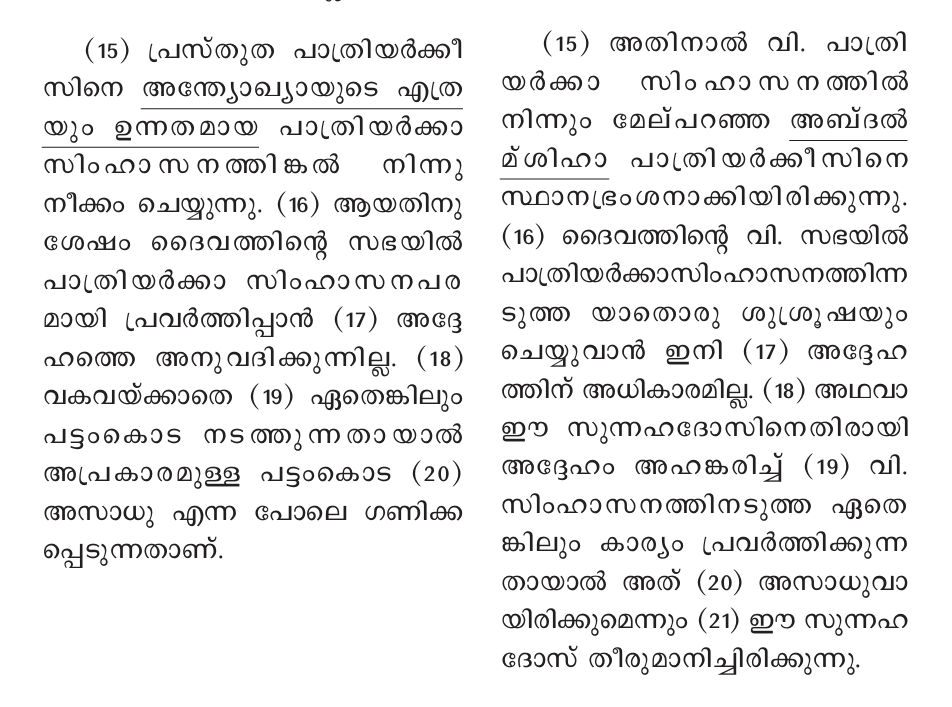
Thirdly, remaining details such as the president of the Synod, the reason for deposition, the number of attendees and so on are inconsistent throughout the early sources. Since going through them all would take much more space, one example would suffice. Sleeba Mor Osthatheos attested before the Fixed Deposit Suit hearing on Vruschikam 27, 1918 that Met. Dionysius Behnam of Mosul presided over the Synod. However, in the Acts of the Synod (which will be discussed below) presented by Met. Yulios Elias Qoro, Met. Dionysius Behnam of Mosul is not among the five metropolitans who attended the Synod! Abdal Ahad Ramban (later Pat. Yakub III), the Malpan at Manjinikkara Dayro, claims that “Mor Koorilos Geevarghese” presided over the Synod (Pratyakshasatyam II:44; 1942); again, however,, the signature of Met. Koorilos is numbered as fourth in the Acts, which would be unlikely if he were the president.
Fourthly, Syriac Orthodox sources including Met. Dolabani state that the Synod took place at Dayr Zaʻfarān (Kurkmo Dayro). However, Pat. Barsoum's History of the Za’faran Monastery (1917) recorded twenty-one councils that took place at the monastery. There is one in 1895, and another in 1906 to elect Pat. Abded Aloho: but interestingly enough, nothing is mentioned about a synod in 1903. Is it because it was convened not to elect a Patriarch but to depose one? Perhaps not, since the fourteenth council (in 1817) which Pat. Barsoum records did not per se elect anyone, as Pat. Matta surrendered his office to Maph. Basil Younan at the Synod. It may be presumed that, if the Synod took place, it was omitted from the list because of its dubious nature.
The Acts of the Synod: A Forgery?
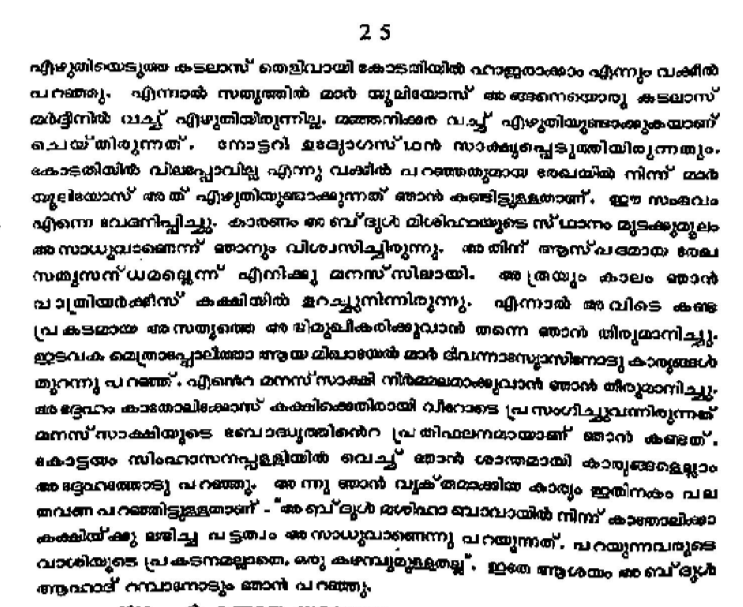
As mentioned above, Met. Yulios Elias Qoro, the Patriarchal Delegate to India, presented a document claiming to be the Acts of the 1903 Synod before the Court. This was dismissed by the Jury, and for good reason. Unlike other synodical proceedings, it doesn't mention key information (e.g. who presided over it or how it was gathered); signatures of attendees are provided but without dates; the overall terminology used (inc. the absence of the traditional title Ignatius) is suspicious. Met. Yulios presented the copy as “attested by a magistrate”, but the officer appears to have seen only the translation, and he has not used his official government-issued seal, but an informal one with only his name. More interestingly, there exist two variant versions of the Acts — one published by Met. Yulios, and the other by Suriyani Sabha 6:227-29 (1932), under Met. Athanasius.
There is something much significant besides this. Fr. V. C. Samuel, the renowned scholar of Christology, was brought up in a pro-Patriarch family. He studied at Manjinikkara Dayro, under Met. Yulios Elias. In his autobiography, Swanubhavavediyil, Fr. Samuel describes how he witnessed Met. Yulios forging the Acts by his own hands. This event would greatly influence him, leading him to become Malankara Orthodox later on.
Conclusion: Nature of The Deposition
From consulting the primary sources in the period 1905-1910, we see that Pat. Abded Mshiho II was clearly deposed by the Ottoman Sultan. Could there have been a synod composed of metropolitans and priests who gathered to depose Pat. Abded Mshiho? Given the evidence, which is largely incoherent and inconclusive for the existence of such a synod, likely not. If it did take place, it was practically nothing more than a meeting, rather than a formal and valid synod of the Syriac Orthodox Church.
The Malankara Church, as well as many if not all Syriac Orthodox communities, continued to perceive Pat. Abded Mshiho as a Patriarch. While sources for the latter are fragmentary, we have more than enough evidence from Malankara to conclude that Pat. Abded Mshiho was seen as valid, albeit undergoing religio-political persecution. It is in this context that St. Dionysius would communicate with the Patriarch, and the latter would arrive in Malankara to establish the Catholicate, following Pat. Abded Aloho's “excommunication” of St. Dionysius.